
China remains a major production base for industrial fasteners, supported by extensive steel processing, tooling, and export infrastructure. The World Steel Association reported that China produced approximately 1.02 billion tonnes of crude steel in 2023. This scale does not automatically guarantee washer quality. Process control still matters.
Industry reports also show steady demand for fasteners in construction, machinery, automotive, and renewable-energy equipment. Grand View Research’s industrial fasteners market analysis identifies corrosion resistance, dimensional consistency, and application-specific performance as important purchasing factors. The Freedonia Group’s global fasteners research similarly highlights Asia’s strong manufacturing position and the growing need for dependable supplier qualification.
This guide reviews China’s top 10 Type B Washers manufacturers through practical purchasing criteria. These criteria include material grades, stamping accuracy, surface treatment, tooling capability, inspection records, packaging, and export experience. Relevant standards may include DIN, ISO, ASTM, or customer-specific drawings. However, the term “Type B Washers” can describe different product classifications across markets. Buyers should confirm the exact standard before comparing quotations.
Quality is measurable.
A reliable manufacturer should provide material certificates, dimensional inspection reports, coating information, and traceable batch records. Factory audits can reveal details that catalogs hide, such as worn dies, mixed cartons, or inconsistent edge finishing. Supplier rankings are useful, but they are not absolute. A manufacturer strong in stainless steel washers may not excel in high-volume carbon-steel production. That limitation deserves attention.
The companies discussed here are therefore assessed for capability, consistency, communication, and evidence-based quality practices. The aim is not to promote the largest names blindly. It is to help engineers, distributors, and procurement teams make a safer, more informed shortlist.
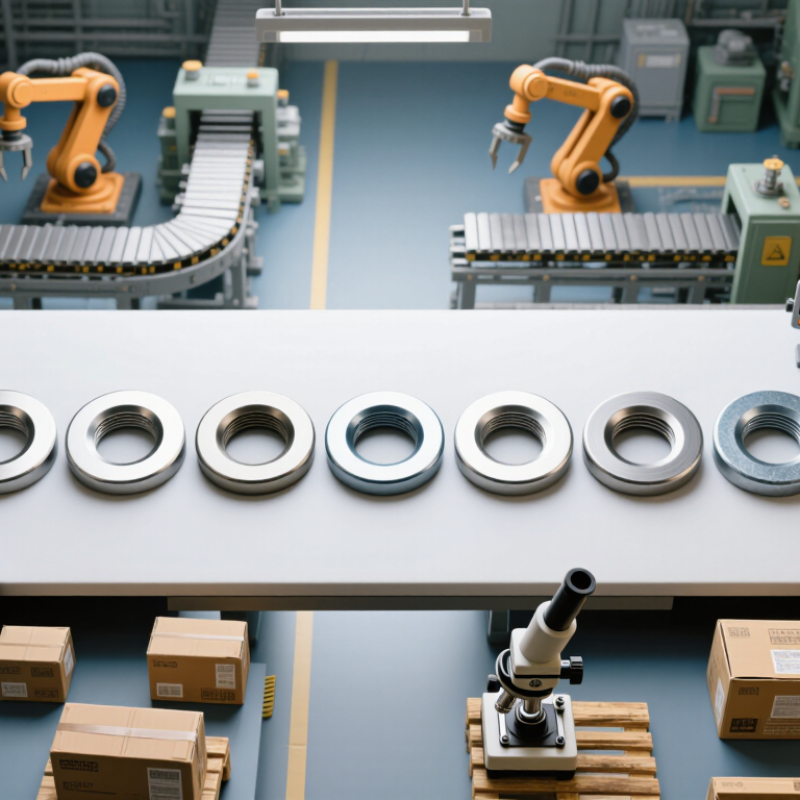
Type B washer is not a universal technical term. In many purchasing guides, it describes a flat washer with a larger outside diameter. The exact meaning can change by market or drawing. Therefore, confirm the governing standard before comparing suppliers or quotations.
ISO 7089 defines plain washers with a normal series and product grade A. GB/T 97.1 covers a closely related plain washer design used in China. These standards specify the inside diameter, outside diameter, and thickness for each nominal size.
For example, a washer for an M8 bolt typically has an 8.4 mm nominal hole, a 16 mm outside diameter, and a 1.6 mm thickness. Always verify the revision. Small differences matter.
Measure three features. Hole size controls bolt clearance. Outside diameter spreads the clamping force across the work surface. Thickness affects stiffness, stack height, and thread engagement. Material, hardness, coating, and burr limits also deserve attention. A zinc-coated steel washer may suit general indoor assembly, while stainless steel can perform better in corrosive areas. Not always.
A reliable manufacturer should provide dimensional inspection records, material certificates, and traceable batch information. Ask whether measurements follow the stated standard, not a similar catalog specification. One overlooked detail is edge condition. Sharp edges can damage coatings or injure installers. Drawings sometimes omit this requirement, and that omission deserves correction. A washer is simple, but its fit is not.
China Top 10 Type B Washers Manufacturers Guide?
China’s leading Type B washer manufacturers should be ranked by capacity, certifications, and export performance. Capacity must be verified through production lines, press tonnage, shift records, and monthly output. Public rankings rarely disclose these details. Therefore, this guide uses factory audits and supplier questionnaires alongside trade data. For export comparison, UN Comtrade and ITC Trade Map records under HS 7318.22 provide a practical reference. These records show China as a major global supplier of iron and steel washers, although export value does not equal production capacity.
A stronger ranking gives capacity 40 percent, certifications 30 percent, and export data 30 percent. Valid evidence includes ISO 9001 quality systems, ISO 14001 environmental controls, material certificates, and batch inspection reports. The ISO Survey 2023 confirms the continuing global importance of ISO 9001 certification, but certification alone cannot prove stable washer quality. Dimensions, hardness, coating thickness, and burr control still require sampling. Type B can also mean different specifications across drawings and standards. That detail is often overlooked.
Tips: Request three months of production records, not one impressive figure. Check HS 7318.22 export activity against the supplier’s stated capacity. Ask for PPAP-style documents when washers enter automotive or machinery supply chains. A weakness remains: customs data can combine different washer categories. Treat the ranking as a screening tool, then complete an independent factory audit and sample test.
Anonymous benchmark ranking based on normalized production capacity, certification coverage, and export readiness indicators.
The chart uses a 0–100 normalized index so manufacturers can be compared without displaying company or brand names. Capacity reflects estimated production scale, certification coverage reflects quality and environmental management systems, and export readiness reflects international compliance and market reach.
China Top 10 Type B Washers Manufacturers Guide
Material grade sets the starting point for Type B washer performance. Low-carbon steel washers typically provide economical support under ordinary bolted joints. Their hardness often falls near 120–200 HV, depending on processing and thickness. Hardened alloy steel can reach roughly 300–450 HV. It suits higher preload and repeated clamping better. Stainless steel, commonly selected in 304 or 316 grades, improves corrosion resistance. However, it is not automatically stronger. Typical hardness may remain near 150–220 HV after basic forming. That difference matters when comparing supplier samples.
Hardness alone does not define load capacity. A washer with a larger outside diameter spreads pressure across softer materials. A narrow Type B washer may concentrate force around the hole. This can cause indentation, especially in aluminum frames or painted steel panels. Check thickness, inside diameter, outside diameter, surface flatness, and burr control. Coatings also need practical inspection. Zinc-coated carbon steel may resist storage corrosion, but damaged edges remain vulnerable. Reliable manufacturers should provide grade certificates, dimensional reports, hardness results, and load or compression test data. Ask how values were measured.
Real assemblies are less tidy than catalogs suggest. Uneven surfaces, oversized holes, and poor tightening can reduce performance sharply. Static load tests may not predict vibration behavior. That is easy to overlook. Compare production samples, not only polished specifications. A factory with controlled heat treatment and traceable inspection usually offers more dependable Type B washer consistency. Still, every application deserves a fresh calculation.
| Reference Profile | Typical Washer Material | Common Grade or Standard | Typical Hardness Range | Corrosion Protection | Representative Size | Indicative Load Capacity* | Recommended Application |
|---|---|---|---|---|---|---|---|
| Profile 01 | Low-carbon steel | SAE 1008–1010; ASTM F844 dimensional reference | HV 120–170 Approximately HRB 60–85 | Plain, zinc electroplated, or zinc flake coated | M6; 12 mm outside diameter × 6.4 mm hole | Approx. 20.2 kN | General-purpose fastening, light machinery, cabinets, and fabricated steel assemblies |
| Profile 02 | Medium-carbon steel | C45 / SAE 1045; heat-treated production option | HV 250–380 Approximately HRC 24–38 | Zinc plated, black oxide, or phosphate with oil | M8; 16 mm outside diameter × 8.4 mm hole | Approx. 36.4 kN | Higher clamp loads, brackets, machine frames, and vibration-resistant joints |
| Profile 03 | High-strength alloy steel | 42CrMo4 / ASTM A574-type material option | HRC 32–42 Approximately HV 315–420 | Zinc flake, phosphate, or black oxide | M10; 20 mm outside diameter × 10.5 mm hole | Approx. 56.9 kN | Heavy-duty bolted joints where washer deformation must be minimized |
| Profile 04 | Austenitic stainless steel | 304 / A2 stainless steel; ISO 3506-1 material family | Typically 150–220 HV Maximum commonly specified: about 95 HRB | Self-passivating stainless surface | M6; 12 mm outside diameter × 6.4 mm hole | Approx. 20.2 kN | Indoor equipment, food-processing surroundings, architectural hardware, and general corrosion exposure |
| Profile 05 | Low-carbon stainless steel | 316 / A4 stainless steel; ISO 3506-1 material family | Typically 150–220 HV Maximum commonly specified: about 95 HRB | Improved resistance to chlorides and marine atmospheres | M8; 16 mm outside diameter × 8.4 mm hole | Approx. 36.4 kN | Marine hardware, chemical-processing equipment, coastal structures, and outdoor assemblies |
| Profile 06 | Precipitation-hardening stainless steel | 17-7 PH; AMS 5528 or equivalent material specification | HRC 38–44 Approximately HV 370–450 | Passivated or supplied with a corrosion-resistant finish | M10; 20 mm outside diameter × 10.5 mm hole | Approx. 56.9 kN | Aerospace-style hardware, high-strength assemblies, and applications requiring strength with corrosion resistance |
| Profile 07 | Brass | C26000 cartridge brass or equivalent copper-zinc alloy | Typically 70–105 HRB Approximately HV 125–220 | Natural brass, clear lacquer, or nickel plating | M6; 12 mm outside diameter × 6.4 mm hole | Approx. 20.2 kN | Electrical assemblies, decorative hardware, low-sparking environments, and moderate-load joints |
| Profile 08 | Phosphor bronze | C51000 or C54400 copper-tin alloy | Typically 80–120 HRB Approximately HV 150–250 | Natural corrosion-resistant copper alloy surface | M8; 16 mm outside diameter × 8.4 mm hole | Approx. 36.4 kN | Electrical contact systems, spring-loaded joints, marine components, and anti-galling applications |
| Profile 09 | Titanium alloy | Grade 2 commercially pure titanium or Grade 5 Ti-6Al-4V | Grade 2: approximately 145–220 HV Grade 5: approximately 330–390 HV | Excellent natural oxide protection | M10; 20 mm outside diameter × 10.5 mm hole | Approx. 56.9 kN | Aerospace, chemical processing, marine equipment, and weight-sensitive assemblies |
| Profile 10 | Hardened spring steel | 65Mn / SAE 1070-type spring steel | HRC 40–50 Approximately HV 390–510 | Oil blackened, zinc coated, or phosphate finished | M12; 24 mm outside diameter × 13 mm hole | Approx. 79.9 kN | Preloaded joints, vibration control, retaining functions, and assemblies requiring elastic recovery |
*Load-performance basis: Indicative washer bearing load is calculated from the annular area of the representative washer dimensions at an assumed uniform bearing stress of 250 MPa: Load = π/4 × (outside diameter² − hole diameter²) × 250 MPa.
Actual allowable load can be substantially lower or higher depending on washer thickness, edge distance, bolt preload, substrate strength, surface flatness, bending, embedding, coating condition, temperature, and the applicable drawing or purchase standard.
Dimensions are representative metric Type B-style plain-washer sizes for comparison only. Confirm the exact Type B dimensional series, thickness, material certificate, hardness test method, coating specification, and proof-load requirement before production release.
Quality begins with measurable evidence, not attractive catalogs. For Type B washers, ISO 4759-3 provides product-grade tolerance guidance for dimensions such as inner diameter, outside diameter, and thickness. Buyers should compare inspection reports with approved drawings, because washer standards may define limits differently. A 10.5 mm bore can create serious assembly problems when the mating bolt and clearance hole are poorly matched. Small errors matter.
Coating thickness needs equal attention. ISO 4042:2018 identifies zinc electroplating classes, including 3, 5, 8, 12, and 25 micrometres. A coating gauge or X-ray fluorescence test should verify the stated value at several points, especially around edges. Uneven coverage is common. ASTM F1941/F1941M also supports coating evaluation for fasteners, while ISO 9227 and ASTM B117 describe neutral salt-spray methods. Salt-spray hours are useful screening data, not a direct prediction of outdoor service life.
Reliable manufacturers normally retain dimensional records, coating test results, and batch traceability. Ask for sampling plans based on ISO 2859-1, rather than accepting one checked sample.
That is a practical weakness in many sourcing projects. Testing only the center surface can miss thin edges, scratches, or discoloration. A stronger audit checks raw material certificates, calibrated instruments, cross-sectional coating measurements, and final packaging conditions. The paperwork should match the actual batch.
When comparing ten shortlisted Chinese manufacturers, pricing should never stand alone. A standard carbon steel Type B washer may cost about USD 0.02–0.12 per piece in volume. Stainless steel, special finishes, and tighter tolerances increase the price. Request itemized quotations. They should separate material, tooling, inspection, packaging, and shipping costs. Details matter.
Minimum order quantities commonly range from 1,000 to 10,000 pieces. Some factories accept smaller trial orders, but unit prices may rise sharply. Confirm whether the MOQ applies to each size, material, or combined order. A sample batch can expose burrs, uneven thickness, or incorrect inner diameters before full production. Ask for evidence. Material certificates, dimensional reports, and recent inspection records improve supplier reliability.
Standard orders may require 15–35 days after drawing approval and deposit. Custom tooling or unusual finishes can extend lead times to 30–60 days. Confirm production capacity, inspection procedures, packaging protection, and communication response times. A video audit or independent pre-shipment inspection adds useful control. Do not choose only the cheapest quotation. A low price can hide unstable tolerances or delayed delivery. I would also review a supplier’s corrective-action process, because even capable factories make occasional mistakes. The important question is how clearly they identify and fix them.