
China Top 10 Double Eccentric Valve Manufacturers?

China’s double eccentric valve sector has grown from basic production to specialized engineering and export-oriented manufacturing. This change matters.

Double Eccentic butterfly valves reduce seat friction through an offset shaft design. They support tighter shutoff, lower operating torque, and longer service life. These benefits appear in water treatment, power generation, chemical processing, and oil infrastructure.

Greg Johnson, a recognized valve industry educator and author, has stated, “A valve is only as reliable as its application, installation, and maintenance.” His point is practical. A polished catalog cannot replace correct sizing, suitable materials, or disciplined testing.

This article examines China’s top 10 Double Eccentic valve manufacturers through technical and commercial criteria. The review considers design capability, production experience, pressure ratings, sealing systems, material traceability, inspection procedures, certifications, and overseas service. It also considers whether manufacturers can produce resilient-seated, metal-seated, and high-performance butterfly valves for demanding conditions.

Factory visits and project records often reveal more than marketing language. Weld quality, machining consistency, coating thickness, and actuator alignment deserve close attention. Small defects can become serious leakage problems.

Not every large supplier is the best supplier. That is worth remembering.

Some manufacturers show strong engineering but limited international support. Others offer broad export experience but weaker customization. This article recognizes those trade-offs instead of presenting a perfect ranking. Buyers should still verify current certificates, reference projects, test reports, and delivery performance before purchasing.

The goal is straightforward: provide a balanced starting point for engineers, contractors, distributors, and procurement teams comparing Chinese Double Eccentic valve manufacturers. Reliable selection begins with evidence.
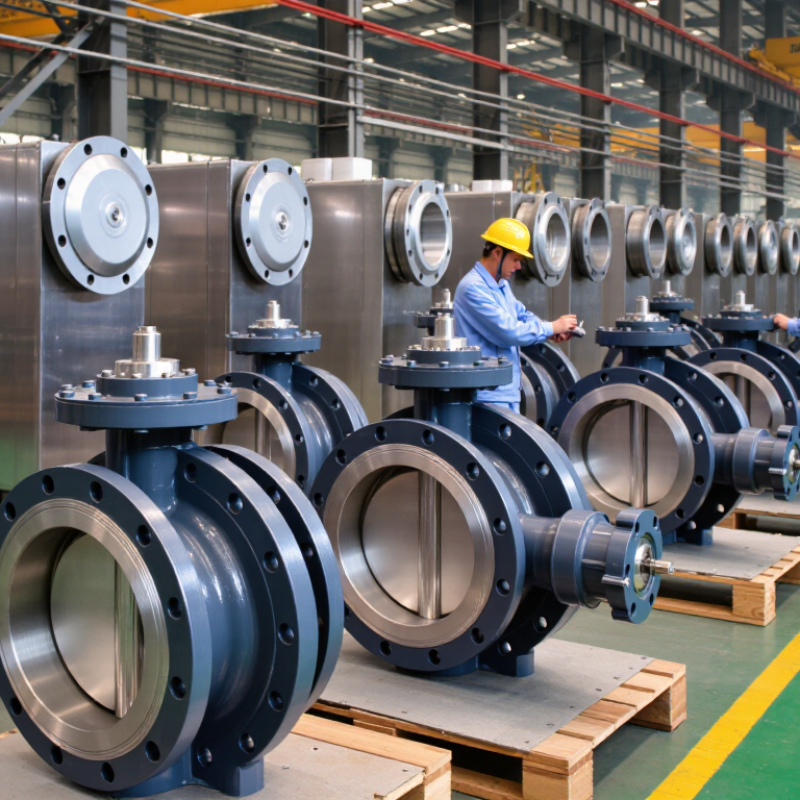
China Top 10 Double Eccentric Valve Manufacturers?

Double Eccentric Valves: Design, Function, and Industrial Applications

Double eccentric valves use a shaft offset from both the disc centerline and the sealing centerline. This geometry reduces seat contact during opening, lowering friction, wear, and operating torque. The disc disengages quickly, like a door leaving its frame. Quarter-turn actuation also supports compact layouts and rapid isolation. API 609 and EN 593 provide relevant design and testing frameworks.

Their strongest applications include municipal water, wastewater, cooling systems, power generation, and selected process lines. The WHO and UNICEF Joint Monitoring Programme reported that 2.2 billion people lacked safely managed drinking water in 2022. That infrastructure gap increases demand for reliable, maintainable flow-control equipment. Grand View Research estimated the global industrial valves market at approximately USD 78 billion in 2023. The estimate includes many valve types, not double eccentric designs alone.

Material selection remains critical. Ductile iron may suit water networks, while stainless steel or higher-grade alloys can improve corrosion resistance. Seat elastomers must match temperature, pressure, and chemical exposure. A double eccentric valve is not automatically ideal for severe throttling; cavitation and unstable flow can develop. Field verification matters more than catalog language. In a top-ten manufacturer assessment, compare leakage testing, cycle data, pressure ratings, traceability, actuator compatibility, and documented service experience. Rankings can mislead when independent operating evidence is missing.

Criteria for Selecting China’s Top Double Eccentric Valve Manufacturers

Criteria for Selecting China’s Top Double Eccentric Valve Manufacturers

Selecting China’s top double eccentric valve manufacturers requires more than comparing prices. Examine their experience with water, chemical, power, or pipeline applications. A capable manufacturer should explain torque calculations, seat design, pressure ratings, and material choices clearly. Vague answers deserve caution.

Request production records, inspection plans, and traceability documents. Check whether each valve receives shell, seat, and operational testing before shipment. Reliable factories can provide calibration records, dimensional reports, and pressure-test results. ISO 9001 certification helps, but it does not replace factory evaluation.

Visit the workshop when possible. Observe machining accuracy, assembly cleanliness, coating control, and storage conditions.

Ask for references from projects using similar sizes and media. Confirm the manufacturer’s ability to support drawings, spare parts, installation guidance, and warranty claims. Delivery capacity also matters. A strong sample may hide weak mass production. That risk is easy to miss. I would compare several production batches, not one attractive inspection report. Local engineering support can reduce delays, especially when the valve operates under high cycling or corrosive conditions. However, technical promises should match documented evidence. Independent inspection may add cost, yet it can expose poor materials or incomplete testing before shipment.

Profiles of Ten Leading Chinese Double Eccentric Valve Manufacturers

China’s double eccentric valve sector includes manufacturers with distinct strengths rather than identical production models. One focuses on large-diameter butterfly valves for water infrastructure. Another serves chemical plants with corrosion-resistant alloy options. A third emphasizes compact designs for district heating systems.

Several factories combine casting, machining, assembly, and pressure testing in one facility. This can improve traceability.

A coastal producer highlights short delivery cycles, while an inland manufacturer offers flexible material selection for demanding media.

Another supplier invests in automated machining to control shaft alignment and disc clearance.

The remaining profiles reveal different priorities. One manufacturer specializes in rubber-lined valves for municipal networks. Another develops metal-seated designs for higher-temperature service. A precision-oriented factory uses coordinate measurement equipment during inspection. One established producer supports custom actuator configurations and documentation packages. The final profile represents a smaller workshop with responsive engineering, but its testing capacity requires careful verification.

Practical buyers should examine body materials, seat performance, torque data, and cycle-test records.

Site audits can reveal more than polished brochures. Published specifications may be incomplete. That matters. Factory experience is valuable, yet every application still needs independent review. Procurement teams should confirm certificates, pressure-test procedures, coating quality, spare-part support, and installation references before approval.

Comparison of Product Quality, Certifications, and Manufacturing Capabilities

China Top 10 Double Eccentric Valve Manufacturers?

Quality comparison should begin with evidence, not catalogue photos. Double eccentric valves need accurate disc alignment, durable seat materials, and stable torque control. API 609 and EN 593 provide useful design references. ISO 9001 certification also matters, but it cannot guarantee leak-free performance. The ISO Survey 2022 recorded more than 1.2 million ISO 9001 certificates worldwide. That scale shows its value, yet certification alone remains insufficient.

Manufacturing capability separates serious suppliers from assembly-focused workshops. Check whether each factory controls casting, machining, coating, pressure testing, and final assembly internally. CNC machining records should show shaft concentricity and sealing-surface tolerances. Ask for hydrostatic and low-pressure air-test reports. Independent inspection adds credibility. MarketsandMarkets estimated the industrial valves market at about 79.4 billion US dollars in 2024, with continued growth expected through 2029. This pressure can encourage faster production, sometimes at the expense of inspection depth. That is the uncomfortable part. Factory audits should review calibration dates, traceability codes, and rejected-part records. A clean showroom proves little.

Tips: Request material certificates for body, disc, shaft, and seat. Verify PED, ISO 14001, ISO 45001, or SIL documents against their issuing bodies. Compare torque curves under real operating temperatures. Also inspect three finished valves, not one sample. This method is not perfect, but it exposes inconsistencies early.

How to Choose a Reliable Chinese Double Eccentric Valve Supplier

Choosing a Reliable Chinese Double Eccentric Valve Supplier

China’s double eccentric valve market includes many capable factories, but quality varies sharply. Industry reports from Grand View Research and Fortune Business Insights estimate the global industrial valve market will continue growing through 2030. Their figures differ because product categories and regional data are not identical. This is worth remembering before trusting any market claim.

A reliable supplier should provide material certificates, pressure-test records, torque curves, and dimensional inspection reports. Ask whether testing follows ISO 5208 or API 598, where applicable. For water, wastewater, and industrial pipelines, verify body material, disc alloy, shaft design, seat compound, coating thickness, and corrosion resistance. A supplier with documented traceability can identify each batch, operator, and inspection result. Factory experience matters more than polished photographs. Request a live production video or conduct an independent audit. I once saw a specification accepted too quickly; the valve passed bench testing but required excessive field torque. That mistake was avoidable.

Tips: Compare three suppliers using the same technical sheet. Request two recent project references, not generic testimonials. Check whether quoted lead time includes testing and export packing. Confirm spare-seat availability and response time after delivery. Review drawings carefully; small stem or flange deviations can delay installation. A lower price may reflect thinner coating, weaker documentation, or limited inspection. It may also be perfectly reasonable, so investigate rather than assume. Use a sample valve for critical projects, and record every approval in writing.

China Top 10 Double Eccentric Valve Manufacturers? - How to Choose a Reliable Chinese Double Eccentric Valve Supplier

Anonymous technical comparison matrix for screening Chinese double eccentric butterfly valve suppliers

Rank Anonymous Manufacturer Profile Typical Size Range Pressure Classes Common Body and Disc Materials Seat and Shaft Options Applicable Standards Quality Documents to Request Export Readiness Best-Fit Application
1 Profile A
Large-project capable
DN100–DN2400
NPS 4–96
PN10–PN40
Class 150–300
Ductile iron, carbon steel, stainless steel; stainless-steel or nickel-alloy disc options EPDM, NBR, PTFE or metal seat; stainless-steel shaft API 609, EN 593, ISO 5752, ISO 5211 EN 10204 3.1 material certificates, hydrostatic test report, dimensional report, coating report High Water transmission, municipal projects and large pipelines
2 Profile B
Industrial specialist
DN80–DN1600
NPS 3–64
PN10–PN25
Class 150
Carbon steel, stainless steel and cast steel; resilient or metal-seated designs PTFE, graphite or laminated metal seat; blowout-proof stem API 609, EN 593, ISO 5208, ISO 5211 Pressure-test records, PMI report where required, NDE records and actuator interface drawing High Power, chemical processing and general industrial service
3 Profile C
Corrosion-resistant focus
DN50–DN1200
NPS 2–48
PN10–PN40
Class 150–300
CF8M, CF8, carbon steel and duplex stainless steel options PTFE, reinforced PTFE, graphite or metal seat; 316 stainless-steel shaft EN 593, API 609, ISO 15848-1 when fugitive-emission service is specified Material traceability, PMI, seat-leakage test and fugitive-emission test where applicable High Seawater, chemical and corrosive-fluid applications
4 Profile D
Cost-effective range
DN100–DN1400
NPS 4–56
PN10–PN16
Class 150
Ductile iron, carbon steel and stainless steel trim EPDM or NBR seat; stainless-steel stem with replaceable packing EN 593, ISO 5752, ISO 5211, ISO 5208 Factory pressure test, coating thickness report, inspection checklist and packing list Medium–High Water treatment, HVAC and low-to-medium pressure service
5 Profile E
High-temperature option
DN80–DN1000
NPS 3–40
PN16–PN40
Class 150–300
Carbon steel, alloy steel and stainless steel Graphite, laminated metal or hard-faced metal seat; high-temperature packing API 609, EN 593, ISO 5208, ISO 5211 Heat-treatment records, hardness report, NDE records and high-temperature seat specification High Steam, hot oil, flue gas and thermal-process systems
6 Profile F
Actuation integration
DN50–DN1200
NPS 2–48
PN10–PN25
Class 150
Ductile iron, carbon steel and stainless steel EPDM, NBR or PTFE seat; manual, pneumatic or electric actuation ISO 5211, EN 593, API 609, IEC 60529 for actuator enclosure rating where specified Valve-actuator compatibility drawing, torque calculation, functional test and wiring diagram High Automated water, utility and process-control systems
7 Profile G
OEM/private-label capable
DN100–DN1800
NPS 4–72
PN10–PN40
Class 150–300
Carbon steel, ductile iron, stainless steel and duplex options Replaceable resilient or metal seat; keyed or square stem designs API 609, EN 593, ISO 5752, ISO 5211 Approved drawings, inspection and test plan, serial-number traceability and spare-parts list High Distribution partners and customized project packages
8 Profile H
Municipal-water focus
DN150–DN2000
NPS 6–80
PN10–PN25
Class 150
Ductile iron or carbon steel body; stainless-steel disc and stem options EPDM drinking-water-grade seat where specified; corrosion-resistant shaft EN 593, ISO 5752, ISO 5211 and applicable potable-water requirements Coating certificate, potable-water compliance documents where applicable, pressure test and inspection report High Raw water, treated water and municipal distribution networks
9 Profile I
Compact project supply
DN50–DN800
NPS 2–32
PN10–PN16
Class 150
Ductile iron, carbon steel and stainless-steel trim EPDM, NBR or PTFE seat; standard ISO 5211 mounting pad EN 593, ISO 5208, ISO 5752, ISO 5211 Routine test report, dimensional inspection, coating report and certificate of conformity Medium Standard replacement, building services and small process lines
10 Profile J
Special-service capable
DN80–DN1000
NPS 3–40
PN16–PN40
Class 150–300
Carbon steel, stainless steel, duplex and hard-faced trim options Metal, graphite or PTFE-based seat; anti-static and fire-safe features when specified API 609, EN 593, ISO 5208 and API 607 or ISO 10497 for fire-safe designs Fire-safe test report where required, NDE records, material certificates and leakage test results High Oil and gas, chemical and critical isolation service
Selection note: The profiles are anonymized technical benchmarks rather than company names or brand claims. Before placing an order, verify the supplier’s current certificates, manufacturing address, traceability system, pressure-test records, material grades, coating specification, actuator torque calculation, delivery capability and after-sales support against the project’s required edition of each standard.

Article Source:

Call (416) 661-5667