
China Top Pool Repair Manufacturers How to Choose?
Choosing among China’s top pool repair manufacturers requires more than comparing catalog prices. It requires evidence from the field.
Grand View Research reports continued growth in the global swimming pool market, driven by renovation and replacement demand. That trend creates opportunity, but it also increases supplier risk. Many companies advertise advanced equipment. Fewer can prove consistent leak testing, surface preparation, material compatibility, and after-sales support.
The CDC’s Model Aquatic Health Code emphasizes inspection, maintenance, operator training, and documented procedures. These principles matter when evaluating pool repair manufacturers. A reliable supplier should provide test records, installation instructions, warranty terms, spare-parts availability, and clear response times. Factory audits can reveal more than polished product pages. Ask for project photographs, export references, and evidence from pools operating in similar climates.
Pool-industry consultant Rudy Stankowitz offers a useful warning: “The cheapest repair is not always the least expensive repair.” The point is practical. A low-priced patch may fail beside a cracked return line, leaving stained tiles, lost water, and another service visit.
The PHTA’s industry guidance also supports preventive maintenance and qualified workmanship. However, reports often describe broad market conditions, not every Chinese manufacturer. That limitation deserves attention. Buyers should verify claims independently, compare technical documents, and test communication before signing a contract.
The best choice is rarely the loudest brand. It is the manufacturer that explains failure causes, measures performance, and accepts accountability after delivery.
Understanding China’s Pool Repair Manufacturing Industry
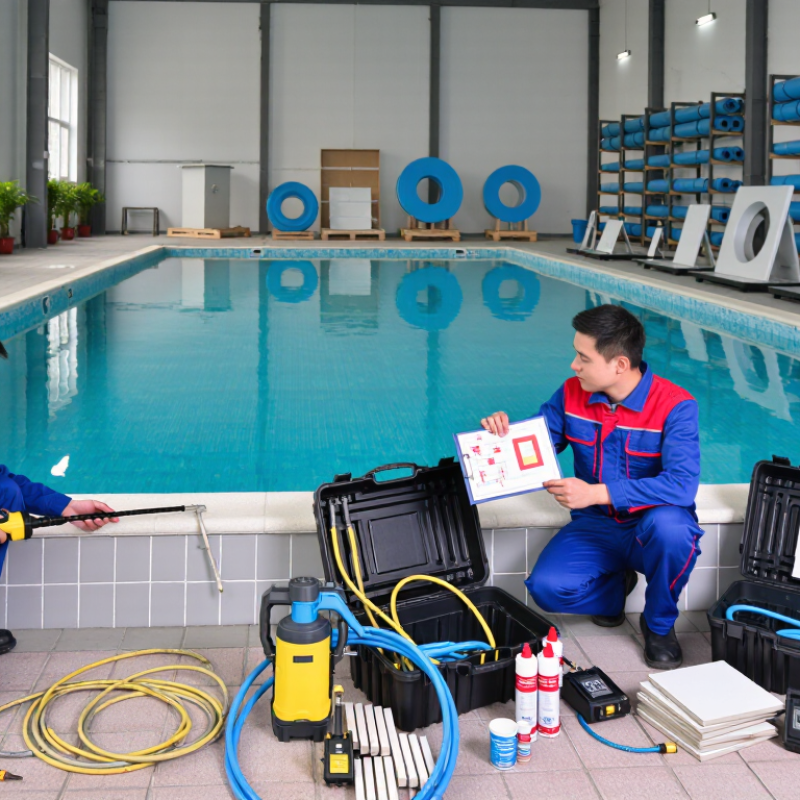
China’s pool repair manufacturing industry serves hotels, residential projects, aquatic centers, and maintenance contractors worldwide. Grand View Research valued the global swimming pool market at about USD 63.8 billion in 2023. It also forecasts a 5.2% annual growth rate from 2024 to 2030. This expansion increases demand for pumps, filters, liners, heaters, valves, and replacement seals. However, a manufacturer producing new equipment may not understand repair conditions. Ask about field experience with cracked housings, calcium deposits, noisy bearings, and unstable water pressure. Real repair knowledge matters.
Factory evaluation should include material testing, production records, and spare-part availability. ISO 9001 certification can show process control, but it does not prove product performance. Request test reports for flow rate, electrical safety, corrosion resistance, and operating noise. Intertek’s market research on pool equipment identifies energy efficiency as a major purchasing factor, so compare measured consumption rather than advertising claims. Look for clear tolerances on shafts, gaskets, and threaded fittings. Small errors create leaks. Often, costly ones. Manufacturers should provide repair diagrams, batch tracking, and realistic lead times. These details reveal reliability better than a polished showroom. A weakness remains: many published market reports combine construction, equipment, and maintenance revenue, making repair-specific comparisons imperfect. Buyers should verify every figure against factory records and independent testing.
China Top Pool Repair Manufacturers How to Choose? - Understanding China’s Pool Repair Manufacturing Industry
| Evaluation Dimension | Typical Industry Data in China | Common Product or Material | Why It Matters | Recommended Verification |
|---|---|---|---|---|
| Repair Product Coverage | Manufacturers commonly supply repair solutions for vinyl liners, fiberglass surfaces, concrete pools, ceramic tiles, filtration systems, pumps, pipes, and fittings. | Patch kits, sealants, replacement fittings, pipe couplings, pump parts, filter components, and surface-repair materials. | A broader product range can reduce the number of suppliers required for one project. | Request a product catalog, technical datasheets, compatibility charts, and application instructions. |
| Material Compatibility | Repair materials must match the pool surface and operating conditions, including water chemistry, ultraviolet exposure, temperature, and permanent or temporary immersion. | PVC and vinyl patches, epoxy compounds, polyurethane sealants, acrylic adhesives, fiberglass resin systems, and rubber gaskets. | Using an incompatible adhesive or sealant may cause poor bonding, leakage, discoloration, or early failure. | Provide the pool-surface type and water-chemistry conditions; request immersion, adhesion, and chemical-resistance test results. |
| Water and Chemical Resistance | Pool repairs are commonly exposed to chlorinated or salt-treated water, cleaning agents, moisture, and repeated wet-dry cycles. | Waterproof tapes, underwater adhesives, two-part epoxy repair compounds, gaskets, and corrosion-resistant hardware. | Resistance to chemicals and continuous moisture directly affects service life and maintenance frequency. | Ask for chemical-resistance data and clear limits for chlorine, salt, pH, temperature, and curing conditions. |
| Manufacturing Capability | Relevant production processes may include injection molding, extrusion, CNC machining, adhesive filling, rubber molding, assembly, and packaging. | Plastic fittings, molded covers, threaded components, custom gaskets, repair tools, and packaged maintenance kits. | The correct process improves dimensional accuracy, repeatability, and product consistency. | Review factory photographs, process flow charts, quality-control checkpoints, and production equipment lists. |
| Customization and OEM Support | Many Chinese manufacturers support custom dimensions, colors, packaging, labels, formulations, and components, subject to tooling or order requirements. | Custom repair kits, private-label packaging, replacement parts, special-thread fittings, and project-specific sealing products. | Customization is useful when standard repair parts do not match an existing pool system. | Confirm drawings, tolerances, mold ownership, sample approval procedures, and change-control requirements. |
| Quality Management | Export-oriented factories may operate under quality-management systems such as ISO 9001, but certification status should be checked for the specific production site. | Batch-controlled adhesives, molded parts, assembled repair kits, and serialized or lot-coded products. | Documented quality procedures help control batch variation, dimensions, packaging, and traceability. | Verify certificate validity, factory address, inspection records, incoming-material controls, and batch-traceability procedures. |
| Product and Export Compliance | Requirements depend on destination market and product type. Chemical products may require safety data, labeling, and transport documentation; electrical products may require applicable electrical and electromagnetic compliance. | Sealants, adhesives, electrical replacement parts, filtration components, and packaged maintenance products. | Non-compliant products may be delayed at customs or restricted from sale in the target market. | Request safety data sheets, technical files, test reports, packaging labels, and destination-market compliance declarations. |
| Testing and Inspection | Useful inspections include visual checks, dimensional inspection, leak testing, pressure testing, adhesion testing, curing checks, and packaging inspection. | Pipe fittings, valves, gaskets, repair patches, sealants, pump components, and assembled kits. | Testing should reflect the actual failure risk, such as leakage, delamination, cracking, or incorrect fit. | Agree on a pre-shipment inspection plan, sampling method, acceptance criteria, and corrective-action process. |
| Minimum Order and Lead Time | Stock items generally have shorter lead times, while custom molded, formulated, or printed products may require sampling, tooling, and production scheduling. | Standard repair kits, replacement parts, custom packaging, private-label products, and made-to-order components. | Minimum order quantities and production schedules affect inventory cost, project timing, and cash flow. | Obtain written details for sample time, tooling time, production lead time, minimum order quantity, and reorder lead time. |
| Packaging and Storage | Adhesives and sealants may require controlled storage conditions, including protection from heat, moisture, freezing, and direct sunlight. Shelf life varies by formulation. | Cartridges, tubes, foil packs, tins, plastic bags, cartons, and complete maintenance kits. | Correct packaging protects product performance and reduces leakage, contamination, and expired inventory. | Check production date, expiry date, storage temperature, carton strength, palletization, and transport restrictions. |
| Technical Support and Warranty | Reliable suppliers should provide installation guidance, repair procedures, troubleshooting support, replacement recommendations, and documented warranty terms. | Repair manuals, application guides, installation drawings, spare parts, and after-sales support documents. | Technical support reduces incorrect installation and helps identify whether a failure is caused by the product or the application. | Request warranty coverage, exclusions, claim procedures, response times, and technical support contacts before placing an order. |
Note: The figures and descriptions above represent common industry practices and typical procurement considerations. Exact specifications, lead times, minimum order quantities, certifications, and test results should be confirmed with each qualified manufacturer for the intended pool type and destination market.
Related Posts
-
How to Find Reliable Swimming Pool Repair Services?
-

Top 10 Tips for Enjoying Your Time at the Public Pool
-

2025 How to Choose the Best New Pool for Your Backyard Oasis
-
Essential Tips for Maintaining a Crystal Clear Water Pool?
-

Top 10 Tips for Choosing the Best Swimming Pool Options?
-
2026 Top Pool Pumps in Canada What Buyers Need to Know?
